
Introduction
Sending money between countries has traditionally involved several financial institutions, currency conversions, and payment processing systems. Depending on the countries involved and the banks handling the transaction, an international transfer may take several business days to complete. Transaction charges, exchange rate differences, and limited access to banking services can also make the process difficult for individuals and businesses.
Stablecoins offer another way to approach international payments. Unlike cryptocurrencies whose market prices can change significantly, stablecoins are designed to maintain a relatively stable value by referencing an underlying asset, such as the US dollar. Examples include USDC and USDT.
By combining stablecoins with blockchain networks, payment providers can transfer digital value between different regions without relying exclusively on traditional correspondent banking channels.
Understanding how this process works requires looking at the complete payment journey, starting with the sender's bank account and ending with the recipient receiving funds in their local currency.
What Are Cross-Border Stablecoin Payments?
Cross-border stablecoin payments involve transferring digital assets between parties located in different countries. Instead of moving conventional currency directly through multiple banking institutions, the sender's funds are converted into stablecoins and transferred through a blockchain network.
Once the digital assets reach the receiving side, they can be converted into the recipient's preferred fiat currency through an exchange or payment service provider.
For example, a business in the United States may need to pay a service provider in India. The sender can initiate a payment in US dollars, convert the amount into a dollar-pegged stablecoin, and transfer it to the recipient's wallet. The recipient can then use an appropriate off-ramp service to convert the stablecoin into Indian rupees.
The blockchain handles the transfer of digital value, while payment providers and financial institutions support the conversion between traditional and digital currencies.
How Does a Cross-Border Stablecoin Payment Work?
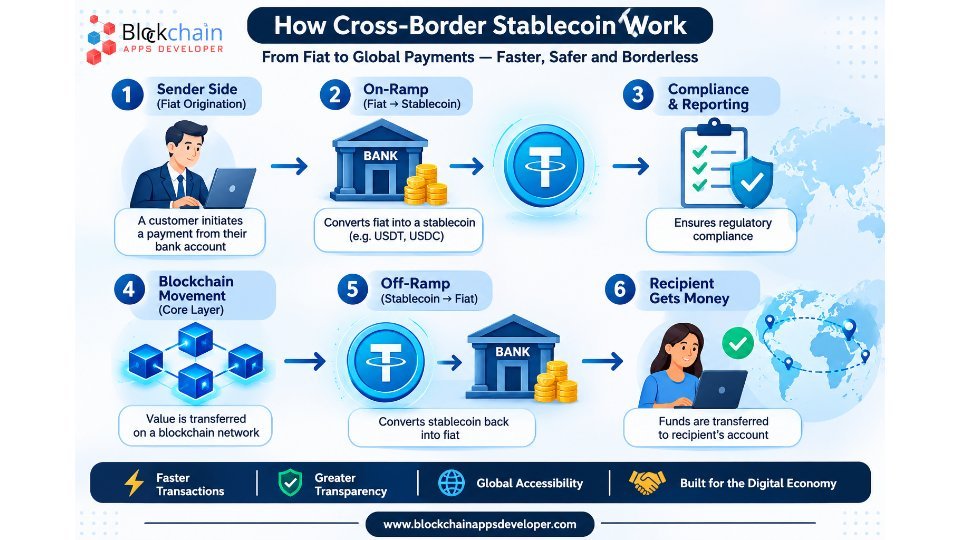
A cross-border stablecoin transaction generally involves six stages. Each stage has a specific purpose in moving funds from the sender to the recipient.
1. Payment Initiation: The Sender's Side
The process begins when a customer or business initiates an international payment using a bank account or another supported payment method.
At this stage, the sender provides the recipient's payment details and specifies the amount to be transferred. The payment provider receives the instruction and checks whether the sender can complete the transaction.
For instance, a company paying an overseas supplier may initiate a payment in USD through a stablecoin payment platform. The platform processes the payment request and prepares the funds for conversion.
The sender does not necessarily need to manage blockchain transactions directly. A payment provider can handle the technical steps through its integrated payment infrastructure.
2. On-Ramp: Converting Fiat Currency into Stablecoins
The next stage is known as the on-ramp process. It converts conventional money, such as USD or EUR, into a supported stablecoin.
The payment provider or exchange receives the fiat funds and arranges the purchase or issuance of the selected stablecoin. Depending on the service, this may involve a banking partner, a regulated exchange, or a stablecoin issuer.
For example, a sender depositing 1,000 USD may receive an equivalent amount of a dollar-pegged stablecoin, after accounting for applicable fees and conversion terms.
The actual amount received depends on the provider's exchange rate, transaction charges, network fees, and service conditions.
This conversion is important because it changes the payment from a traditional currency transaction into a blockchain-based digital asset transfer.
3. Compliance and Transaction Verification
Regulatory compliance is an important part of cross-border stablecoin payments. Digital asset transfers still involve financial crime risks, jurisdictional requirements, and customer verification obligations.
Depending on the provider, transaction type, and applicable regulations, compliance checks may include:
Know Your Customer (KYC) verification.
Anti-Money Laundering (AML) screening.
Sanctions and restricted-party screening.
Transaction monitoring.
Source-of-funds verification.
Recordkeeping and regulatory reporting.
These checks are not necessarily limited to one stage. Payment providers may perform verification before accepting funds, during the transaction, and when processing withdrawals.
A well-designed payment platform should incorporate compliance requirements into its transaction workflow instead of treating them as a separate administrative task.
4. Blockchain Movement: Transferring Stablecoins Across Networks
Once the stablecoins are available for transfer and the necessary checks have been completed, the transaction can be submitted to a blockchain network.
The sender's stablecoins are transferred from one wallet address to another. The blockchain records the transaction and allows network participants to verify its status.
Unlike conventional international transfers that may pass through several correspondent banks, a blockchain transaction can move directly between supported wallet addresses.
However, the transfer speed and cost depend on the selected blockchain network, its transaction capacity, network congestion, and the transaction's confirmation requirements.
Payment providers must also consider wallet compatibility, network support, and the possibility of sending assets through an incorrect network.
This makes blockchain integration and transaction management important parts of a reliable stablecoin payment system.
5. Off-Ramp: Converting Stablecoins Back into Fiat Currency
After the stablecoins reach the recipient's side, they may be converted into traditional currency through an off-ramp service.
The off-ramp provider receives the stablecoins and arranges their exchange into the recipient's preferred fiat currency. The conversion may involve a cryptocurrency exchange, payment processor, liquidity provider, or banking partner.
For example, a recipient in India receiving a dollar-pegged stablecoin may use a supported and legally compliant service to convert the funds into Indian rupees.
The available withdrawal methods and conversion rates depend on the provider and the financial regulations applicable in the recipient's country.
Off-ramp availability is particularly important because receiving digital assets does not automatically mean that the recipient can withdraw equivalent funds into a local bank account.
6. Recipient Receives the Money
The final stage is the settlement of funds to the recipient.
Once the off-ramp provider completes the conversion and processes the withdrawal, the recipient receives the money through a supported payment channel, such as a bank account or another permitted payout method.
The recipient may also choose to retain the stablecoins instead of converting them, depending on their needs and the applicable rules.
At this point, the payment journey is complete. The sender has transferred value from one country, and the recipient has received the corresponding funds in a usable form.
Key Components Behind Stablecoin Payment Infrastructure
A cross-border stablecoin payment system depends on several interconnected technologies and service providers.
1. Blockchain Network
The blockchain provides the infrastructure for recording and validating digital asset transfers. The choice of network affects transaction fees, confirmation times, supported tokens, and wallet compatibility.
2. Stablecoin Smart Contracts
Smart contracts manage token-related operations, including transfers, balance updates, and other functions supported by the stablecoin's design. Their implementation and security are important for maintaining reliable transactions.
3. On-Ramp and Off-Ramp Integration
Payment gateways, exchanges, and financial service providers connect traditional payment systems with blockchain networks. These integrations make it possible to deposit fiat currency and withdraw converted funds.
4. Digital Wallet Infrastructure
Wallets allow users and payment providers to hold, send, and receive stablecoins. Secure key management, transaction authorization, and wallet monitoring are essential components.
5. Compliance and Monitoring Systems
Compliance infrastructure supports identity verification, transaction screening, risk assessment, and recordkeeping. Its requirements vary according to the provider's role and the jurisdictions involved.
Benefits of Using Stablecoins for International Payments
Stablecoins can provide practical advantages for businesses and individuals involved in international transactions.
Reduced dependence on intermediary banking channels: Blockchain-based transfers can reduce the need to route every payment through multiple correspondent banks, depending on the payment arrangement.
Faster transaction processing: Transfers on supported blockchain networks can be confirmed more quickly than some traditional international payment routes. The complete payment may still take longer if banking conversions or compliance reviews are required.
Greater payment visibility: Blockchain transactions can be independently verified, making it easier to track on-chain movement and confirmation status.
Access to global payment infrastructure: Businesses can use supported blockchain networks to transfer digital assets across geographical boundaries without depending entirely on conventional banking transfer systems.
Flexible payment integration: Stablecoins can be incorporated into digital wallets, merchant payment systems, business platforms, and financial applications.
Challenges to Consider Before Implementing Stablecoin Payments
Despite their potential, stablecoin payments require careful technical and operational planning.
Regulatory requirements differ across countries, and a payment provider must understand the rules governing digital asset transfers, custody, exchange, and fiat payouts.
Liquidity is another consideration. A stablecoin may have sufficient on-chain availability, but the recipient's local market may not offer convenient conversion or withdrawal options.
Security also requires attention. Wallet vulnerabilities, compromised private keys, incorrect transaction addresses, and smart contract weaknesses can create financial risks.
Businesses must additionally evaluate stablecoin issuer transparency, redemption arrangements, blockchain network reliability, transaction fees, and the availability of suitable banking partners.
Addressing these factors before launching a payment platform can help prevent operational problems as transaction volumes increase.
Conclusion
Cross-border stablecoin payments bring together traditional banking services, digital asset conversion, blockchain infrastructure, and local payout systems. Each component contributes to moving funds from the sender to the recipient.
Their usefulness depends not only on blockchain transaction speed but also on the availability of reliable on-ramp and off-ramp services, adequate liquidity, secure wallet infrastructure, and compliance with applicable financial regulations.
For businesses exploring international payment solutions, stablecoins offer an alternative infrastructure worth evaluating. Building such a system requires more than deploying a token contract; it involves integrating payment services, blockchain networks, security mechanisms, and transaction monitoring into one coordinated platform.
As digital asset infrastructure develops, stablecoin-based payment systems may become an increasingly relevant option for businesses looking to improve how they manage international money transfers.